Table of Contents
ToggleThe Technical Cadet Course preliminary test is much more difficult than the PMA Long Course and this is because it tests not just general knowledge but also FSc level Physics, Mathematics, and advanced reasoning ability. Thousands of students apply for TCC every year, but only those who follow structured test prep succeed.
TCC Verbal Test No 2
Buy TCC Premium Notes In 300
TCC Academic Test No 2
Buy TCC Premium Notes In 300
Technical Cadet Course test prep is not complete by just reading books. Sample PDFs, past papers, intelligence test practice, subject-wise MCQs with answers, and time management all play different roles. This article will provide everything competitors’ articles lack, from practical study plans to free downloadable resources and intelligence test speed-building techniques.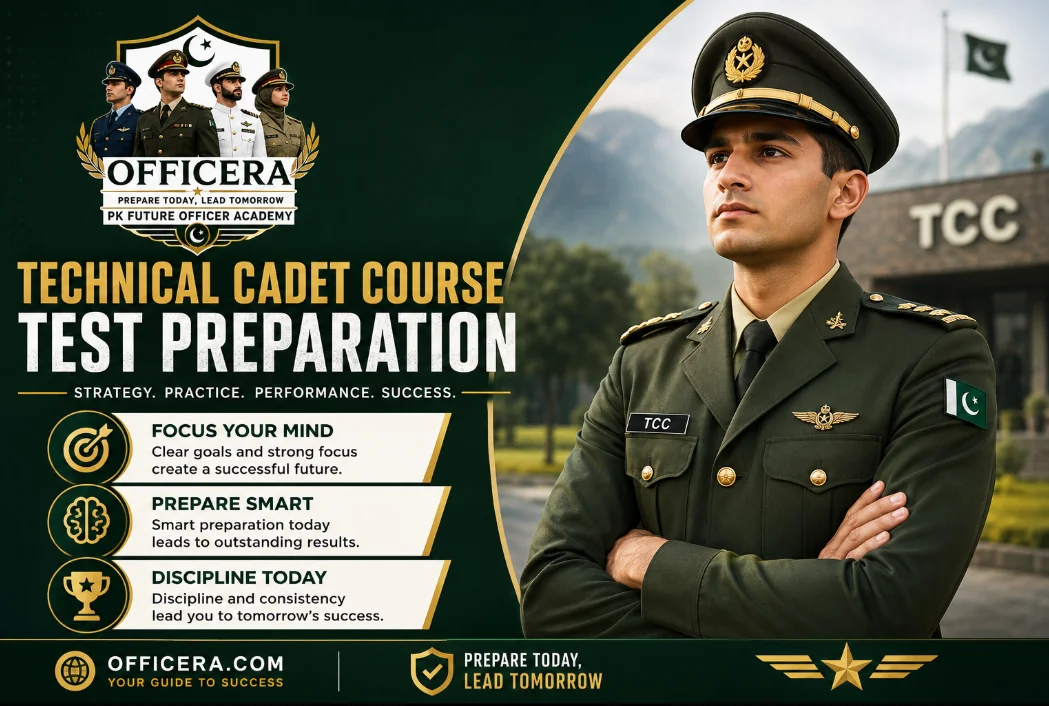
Technical Cadet Course Test Sample PDF
The Technical Cadet Course test sample PDF is the first document every serious candidate should download on their first day of preparation. This PDF shows you the actual structure of the TCC preliminary test, question types, section order, and difficulty level all in one place.
The sample PDF contains three sections. The first section contains verbal intelligence practice questions such as word analogies, letter series, and coding-decoding. The second section contains pattern-based questions for non-verbal reasoning. The third section contains academic MCQs from Physics, Mathematics, English, and Chemistry, which are of FSc pre-engineering level.
Many candidates prepare by just reading the syllabus and ignore the sample paper and this is a big mistake. The best way to understand the TCC test pattern is to solve a complete sample paper under timed conditions. If you don’t practice solving 84 verbal MCQs in 30 minutes, you will face time constraints in the actual exam.
Free TCC sample PDFs are available on Pakshaheens.com, ilmiway.net, and pakarmyguide.com. These resources are based on past test experiences of the Pakistan Army and are regularly updated. Don’t start with just one sample, solve at least five different sample sets today to get a grasp on the pattern.
Pro Tip: After solving the sample PDFs, analyze the incorrect answers. Start over from the topics with the most mistakes and this targeted approach is three times more beneficial than general revision.
Technical Cadet Course Initial Test
The Technical Cadet Course Initial Test is conducted at the Pakistan Army’s Army Selection and Recruitment Centers and is a computer-based test conducted on touchscreen or desktop computers. This is the first and most filter-heavy stage of TCC selection.
The TCC initial test has three parts:
| Test Section | Details |
|---|---|
| Verbal Intelligence | 84 MCQs, 30 Minutes |
| Non-Verbal Intelligence | 64 MCQs, 30 Minutes |
| Academic Test | 50 MCQs, 30 Minutes |
The Verbal Intelligence section includes questions on mirror images of alphabets, word series, analogies, coding-decoding, and odd-one-out questions. Each question is limited to 21 seconds, so speed training is essential.
The Non-Verbal Intelligence section includes questions on shape series, pattern completion, figure rotation, and paper folding. This section is difficult for candidates who only consult academic books and don’t practice reasoning.
The Academic test consists of 50 MCQs based on Physics, Mathematics, English, and Chemistry or Computer Science. These MCQs focus on FSc pre-engineering-level concepts, formulas, theorems, and definitions. Learn the concepts by heart instead of memorizing them.
One important point that’s missing from competitive articles is that passing each section of the TCC preliminary test is essential. Simply achieving an overall average isn’t enough. If you score 90 percent on the academic test but fail the intelligence section, you’ll be rejected. Therefore, balanced preparation with equal attention to all three sections will prevent failure.
The physical test and preliminary medical examination occur after passing the intelligence test. The physical test requires a 1.6 km run in 8 minutes, 15 push-ups, 20 sit-ups, and 3 chin-ups.
Technical Cadet Course Notes
Technical Cadet Course notes are structured study materials that help you understand concepts in an organized manner. Just practicing MCQs is not enough because if the underlying concepts of Physics, Mechanics or Electricity are not clear then you will make mistakes in application-based questions.
The subject-wise breakdown for TCC notes is:
These chapters are important in Physics notes: Mechanics including Newton’s Laws, work, energy, power; Electricity and Magnetism including Coulomb’s Law, Ohm’s Law, circuits; Optics including reflection, refraction, lenses; Thermodynamics including heat, temperature, gas laws; Waves including types, frequency, amplitude. Maximum MCQs are given in Physics TCC test, hence spend maximum time on this subject.
Mathematics notes in Algebra including quadratic equations, polynomials; Trigonometry including identities, equations; Calculus including basic differentiation and integration; Geometry including circles, triangles, coordinate geometry cover.
English notes in Grammar including parts of speech, tenses, active passive voice, narration; Vocabulary including Synonyms, Antonyms, idioms, pair of words; Comprehension including passage reading and inference skills cover.
Basic definitions, chemical equations, Formulas, periodic table, and fundamental concepts of organic chemistry are sufficient in Chemistry notes.
These notes are available for free in subject-wise PDFs on pakshaheens.com with English Test PDFs from 1 to 7, Physics PDFs from 1 to 8, and Mathematics PDFs from 1 to 25. This collection is Pakistan’s biggest free notes repository for TCC candidates.
Pro Tip: Read the notes and practice MCQs. Read one chapter first, then solve 20 MCQs from that chapter, then the next chapter. This chunked learning method provides 4 times more retention than just reading.
Technical Cadet Course Past Papers
Technical Cadet Course past papers are an essential part of preparation, providing real-world exam experience. Candidates from TCC 34, TCC 35, and TCC 37 batches have shared their test experiences online and these are the most reliable sources of actual exam questions and patterns.
Important trends emerging from the past papers are that in Physics, Electricity, Magnetism, and Optics generate the most MCQs. In Mathematics, Algebra and Trigonometry are dominant topics. Verbal intelligence consists of mirror images of alphabets, word patterns, and analogies repeated questions. Non-verbal mein series completion and odd-one-out are the most common question types.
| Subject | High-Frequency Topics |
|---|---|
| Physics | Electricity, Magnetism, Optics |
| Mathematics | Algebra, Trigonometry |
| English | Grammar, Synonyms, Antonyms |
| Chemistry | Formulas, Basic Definitions |
| Verbal Intelligence | Analogies, Coding, Series |
| Non-Verbal | Patterns, Mirror Images |
TCC past papers are available on Scribd, issbpsychologist.com, and pakshaheens.com. TCC 35 preliminary test experiences are compiled in a PDF that covers frequently asked questions in Physics and Mathematics.
Use past papers properly by first solving the paper yourself, then checking the answers, and then understanding the concept of each incorrect question. Reviewing past papers and solving them are two completely different things because only solving is what works.
TCC Test Preparation Book PDF
TCC test preparation book PDF is a single resource that provides intelligence tests, academic MCQs, past papers, and preparation strategies in one place. These books are specifically designed for preparation for the Technical Cadet Course, and several versions are available on the market.
The best TCC preparation books, the Niazi Forces Academy and Shaheen Forces Academy guides, contain over 1,000 verbal, non-verbal, and academic MCQs in solved form. These books cover important chapters in Physics including Mechanics, Electricity, Magnetism, and Optics and solved examples of Mathematics in Algebra, Calculus, Trigonometry, and Geometry, along with explanations.
TCC preparation guides written by Malik Asif are very popular among candidates. His books include subject-wise breakdowns, common mistakes, and exam tips. These books are available in physical format from the market and online in PDF format.
When selecting a book, ensure it complies with the latest TCC test pattern. The Pakistan Army frequently updates its test pattern and older books may mismatch the pattern. Prefer books published or updated for 2025-2026.
An important tip is to not rely solely on one book. Get a main preparation book, and use free online PDFs and past papers as supplementary material. This combination yields significantly better results than just one book.
TCC Test MCQs with Answers
TCC test MCQs with answers are practice material that allows candidates to assess their preparation level. The advantage of solving MCQs with answers is that you understand the reason for choosing the wrong option and this process is more beneficial than simply memorizing the correct answer.
These topics are common in Physics MCQs: application questions of Newton’s Laws of Motion, work-energy theorem, parallel and series circuits, Snell’s law and total internal reflection in optics, and wave properties. Questions with direct application of formulas can be solved faster if the formulas are firmly in mind.
Quadratic equations, logarithms, and sets from Algebra are common in Mathematics MCQs. Identities and equations are frequent in Trigonometry. Differentiation rules and simple limits are common in Calculus. In Geometry, questions arise from circle theorems and coordinate geometry.
English MCQs cover parts of speech, tenses, active-passive voice, and narration from grammar. Synonyms and antonyms are common in vocabulary. Comprehension passages contain inference and main idea questions.
Intelligence MCQs have a completely different style. In Verbal, coding-decoding, number-letter series, and word analogies require speed and pattern recognition. In Non-Verbal, shapes, patterns, and figure rotation test visual thinking.
The most effective way to practice MCQs is to do two sessions a day with one 30-minute timed session of intelligence MCQs, and one 30-minute session of academic MCQs. Follow this routine consistently for 6 weeks.
TCC Test MCQs with Answers PDF Free Download
TCC test MCQs with answers PDF free download is needed for candidates who cannot afford paid resources or prefer to rely solely on online materials. The good news is that many reliable platforms in Pakistan provide this material genuinely free.
Pakshaheens.com offers the most comprehensive free material. English Test PDFs 1 to 7, Physics PDFs 1 to 8, Mathematics PDFs 1 to 25, and Chemistry PDFs 1 to 4 are all available for free access. Each PDF contains solved MCQs with answers.
The TCC PDF notes and books section on Ilmiway.net has separate PDFs for Physics, Mathematics, Chemistry, English, and Intelligence Test available for download. This material is based on past experiences.
On the Issbpsychologist.com forums, TCC past batch candidates have shared their actual test experiences, which also mention the topics of questions asked in the real exam. This is an unofficial source but is very useful for getting a feel for the real exam.
Keep these things in mind while downloading free PDFs: Download only from trusted and established websites. Downloading files from unknown sites carries the risk of malware. Before downloading a file, check whether the material is as per the latest TCC pattern or from an old batch. If the PDF doesn’t have answers, it’s only half as useful for practice, so download the PDFs with answers.
TCC Academic Test Preparation
TCC academic test preparation requires a strategic approach, as you must solve 50 MCQs in just 30 minutes with an average of 36 seconds per question. This speed is only achieved when the concepts are crystal clear in your mind and your hands are already trained by practicing MCQs.
Physics is the most important academic subject. In Mechanics, cover Newton’s three laws, projectile motion, friction, work, power, and energy theorems. Electricity and Magnetism, cover Ohm’s Law, Kirchhoff’s Laws, series and parallel circuits, and basic concepts of Magnetism. In Optics, equations for reflection, refraction, critical angle, and lenses are essential. Thermodynamics, heat transfer, specific heat, and ideal gas laws are sufficient.
In Mathematics, start with Algebra including quadratic equations, inequalities, sets, and functions. Then Trigonometry including standard identities, equations, and graphs. Calculus, cover the power rule of differentiation, the chain rule, and simple limits. In Geometry, cover coordinate geometry, circle theorems, and area formulas.
English, practice is more important than memorizing grammar rules. Solve 50 grammar MCQs daily. For Vocabulary, learn 15 new synonyms and antonyms daily so that more than 600 words can be covered in 6 weeks. For comprehension, practice identifying key ideas and inferences by reading English passages at speed.
Choose the subject you performed better in in your FSc, either Chemistry or Computer Science. In Chemistry, mole concepts, chemical equations, periodic trends, and basic organic chemistry. In Computer Science, hardware, software, basic programming concepts, and networking fundamentals are sufficient.
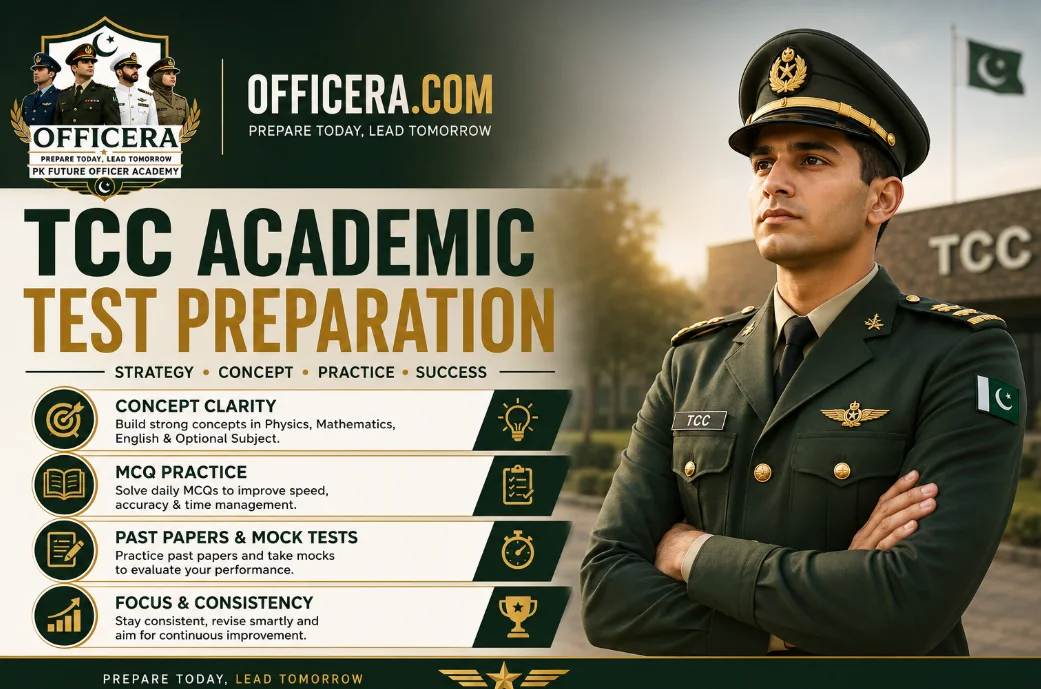
TCC Academic Test Preparation Step-by-Step Plan
First Step: Subject Assessment (Days 1 to 3)
First, take a diagnostic test by randomly solving 20 MCQs from each subject and see your scores. Spend the most time on the subject with the lowest score. This step isn’t done in competitive articles because people jump straight to the exam without identifying weaknesses.
Second Step: Concept Clarity Phase (Days 4 to 20)
Start making notes on high-frequency topics in each subject. Prioritize Mechanics and Electricity in Physics. Complete Algebra and Trigonometry first in Mathematics. Don’t cram concepts, instead understand them and create your own examples. If a concept isn’t clear even after explaining it three times, watch an explanation video on YouTube.
Third Step: MCQ Drill Phase (Day 21 to 35)
Now solve 100 academic MCQs daily with 30 Physics, 30 Mathematics, 20 English, 20 Chemistry. Set a timer. Note down questions with incorrect answers and repeat those concepts. Both speed and accuracy improve in this phase.
Fourth Step: Past Papers Phase (Day 36 to 45)
Now solve TCC past papers under timed conditions. Complete the entire academic section in 30 minutes. Track your score. If your score improves, your strategy is working.
Fifth Step: Mock Test Phase (Day 46 to 55)
Complete mock tests covering all three sections including verbal, non-verbal, and academic. Simulate the pressure of the real exam. These mock tests provide the feel of the actual TCC preliminary test and reduce exam anxiety.
Sixth Step: Revision Week (Day 56 to 60)
Revise only high-frequency topics and your weak areas. Don’t start new topics. Review your list of formulas, synonyms, and antonyms once. Maintain physical fitness, as there’s a physical test as well.
Pro Tip: If you find a question difficult in the academic test, don’t dwell on it for more than 15 seconds, skip it and move on. If you have time left at the end, come back. Spending time on one difficult question is wasting three easy ones.
TCC Intelligence Test Preparation
TCC intelligence test preparation is the least-focused part, and this is why 70 percent of candidates fail the intelligence section despite good academic preparation. Verbal intelligence consists of 84 MCQs and non-verbal intelligence consists of 64 MCQs, to be solved in just 30 minutes each.
Cover these topics when preparing for verbal intelligence:
Word Analogies involve understanding the relationship between two words, then finding the same relationship in the other pair. Letter Series involve finding patterns in the alphabet and filling in the gaps. Coding-Decoding involve understanding the rules for converting letters or numbers into a code. Mirror Images of Alphabets require memorizing the mirror view of each alphabet and this is commonly encountered in TCC. Odd One Out involves finding a common pattern in 3 out of 4 words and identifying the 4th.
Preparing for non-verbal intelligence requires developing visual thinking. Figure Series involve identifying patterns in how shapes evolve. Pattern Completion involves finding the missing piece in an incomplete pattern. Paper Folding involves folding paper to create holes and determining where the holes will appear when unfolded. Figure Rotation involves matching the shapes by mentally rotating them.
There’s a proven way to improve your speed on Intelligence tests: Focus solely on accuracy for the first two weeks and solve each question thoughtfully. Then, use a timer for the next two weeks and increase your speed. Take full-time mock tests in the final two weeks. This three-phase approach yields significantly better results than random practice.
Statistics and Data Block
The Pakistan Army TCC selection rate is approximately 3 percent according to Pakistan Army official recruitment data, 2024.
Approximately 70 percent of candidates fail the intelligence section of the TCC preliminary test according to issbpsychologist.com forum candidate experiences, 2025.
25 Mathematics PDFs, 8 Physics PDFs, and 7 English PDFs are available for free for the TCC on Pakshaheens.com according to Pakshaheens.com resource page, 2026.
The TCC academic test has only 30 minutes for 50 MCQs with an average of 36 seconds per question according to Pakistan Army AS&RC official test format, 2025.
The TCC physical test requires completing a 1.6 km run in 8 minutes according to Pakistan Army official TCC eligibility criteria, 2025.
Expert Insight
Candidates who focus only on academic subjects and consider intelligence tests secondary suffer the most. The majority of candidates who fail the TCC intelligence test are those who were academically strong but hadn’t practiced reasoning. Practicing intelligence tests is a skill and one should not rely on natural ability.
Attribution: Senior military coaching instructor, Pakistan Army preparation academy, 2025.
Mistakes and Common Mistakes
The most common mistake is that candidates take intelligence tests for granted and this thinking is wrong. Solving 84 questions in TCC verbal intelligence in 30 minutes with 21 seconds per question is easy only for those candidates who practice regularly.
The second big mistake is that people download free PDFs and just read them instead of solving them. TCC MCQs are beneficial only when you attempt them yourself by picking up a pen or answering on the screen.
The third mistake is that candidates do their entire preparation only from one book or one website. Multiple sources including notes, past papers, mock tests, and timed practice are all necessary for TCC preparation.
Frequently Asked Questions
Q: How many sections are there in the TCC test?
A: The TCC preliminary test has three sections. The Verbal Intelligence Test consists of 84 MCQs to be answered in 30 minutes, the Non-Verbal Intelligence Test consists of 64 MCQs to be answered in 30 minutes, and the Academic Test consists of 50 MCQs to be answered in 30 minutes. Passing all three sections is mandatory.
Q: What subjects are included in the TCC Academic Test?
A: The TCC Academic Test includes Physics, Mathematics, English, and Chemistry or Computer Science. Candidates choose one subject from Chemistry and Computer Science. These are all at the FSc pre-engineering or FSc computer science level.
Q: How much time is required to prepare for the TCC test?
A: TCC test preparation requires at least 6 to 8 weeks of focused preparation. If your FSc foundation is strong, 6 weeks is sufficient. If concepts are weak, allow 8 to 10 weeks especially dedicating extra time to the Physics and Intelligence sections.
Q: Where can I find free PDFs for the TCC test?
A: Free TCC test PDFs are available at pakshaheens.com, ilmiway.net, and pakarmyguide.com. Pakshaheens has 25 Mathematics PDFs, 8 Physics PDFs, and 7 English PDFs for free access. These resources are based on past test experiences.
Q: How difficult is the TCC intelligence test?
A: The TCC intelligence test is difficult for first-time candidates. Approximately 70% of candidates fail the intelligence section. Regular daily practice makes this section manageable because practice matters more than natural ability.
Q: What is the difference between the TCC test and the PMA Long Course test?
A: The TCC preliminary test is more difficult than the PMA Long Course test because the TCC tests advanced FSc-level concepts in Physics and Mathematics. The PMA test covers general academics, while the TCC requires a deeper understanding of engineering-specific subjects.
Q: Does the TCC test have negative marking?
A: The TCC preliminary test does not have negative marking. Therefore, never leave any question blank because even if you don’t know the answer, make an educated guess. Leaving a blank and a wrong answer both result in the same score, so leaving a blank is a mistake.
Q: Where can I find TCC past papers?
A: TCC past papers are available on issbpsychologist.com forums, Scribd, and pakshaheens.com. Real test experiences of candidates from TCC 34, TCC 35, and TCC 37 batches have been shared on the forums. These are the most reliable sources for actual exam patterns.
Q: How many questions from Physics appear in the TCC test?
A: Physics is the subject with the highest weightage in the TCC academic test. Of the 50 MCQs in the Academic section, approximately 15 to 20 questions are from Physics. Mechanics, Electricity and Magnetism, and Optics account for the most questions.
Q: Can the TCC test be taken online from home?
A: No, the TCC preliminary test cannot be taken online from home. This test is taken in-person on a computer at Army Selection and Recruitment Centers (AS&RC). Candidates must report to their nearest AS&RC center with their roll number slip.
Conclusion
Technical Cadet Course test preparation is a multi-layered process that cannot be achieved simply by studying books. The three most important takeaways are: First, pay as much attention to the TCC intelligence test as to the academic test because this is the section that fails the most candidates. Second, take full advantage of free resources including PDFs, past papers, online mock tests because comprehensive material is available absolutely free on websites like pakshaheens.com. Third, timed practice is not just an option but a necessity because solving 84 verbal MCQs in 30 minutes is not possible without training.
Start your Technical Cadet Course test prep now by thttps://pakshaheens.comaking a diagnostic test, identifying weak areas, and following a structured 6-week plan. This is the clearest path to being commissioned as a Captain in the Pakistan Army.