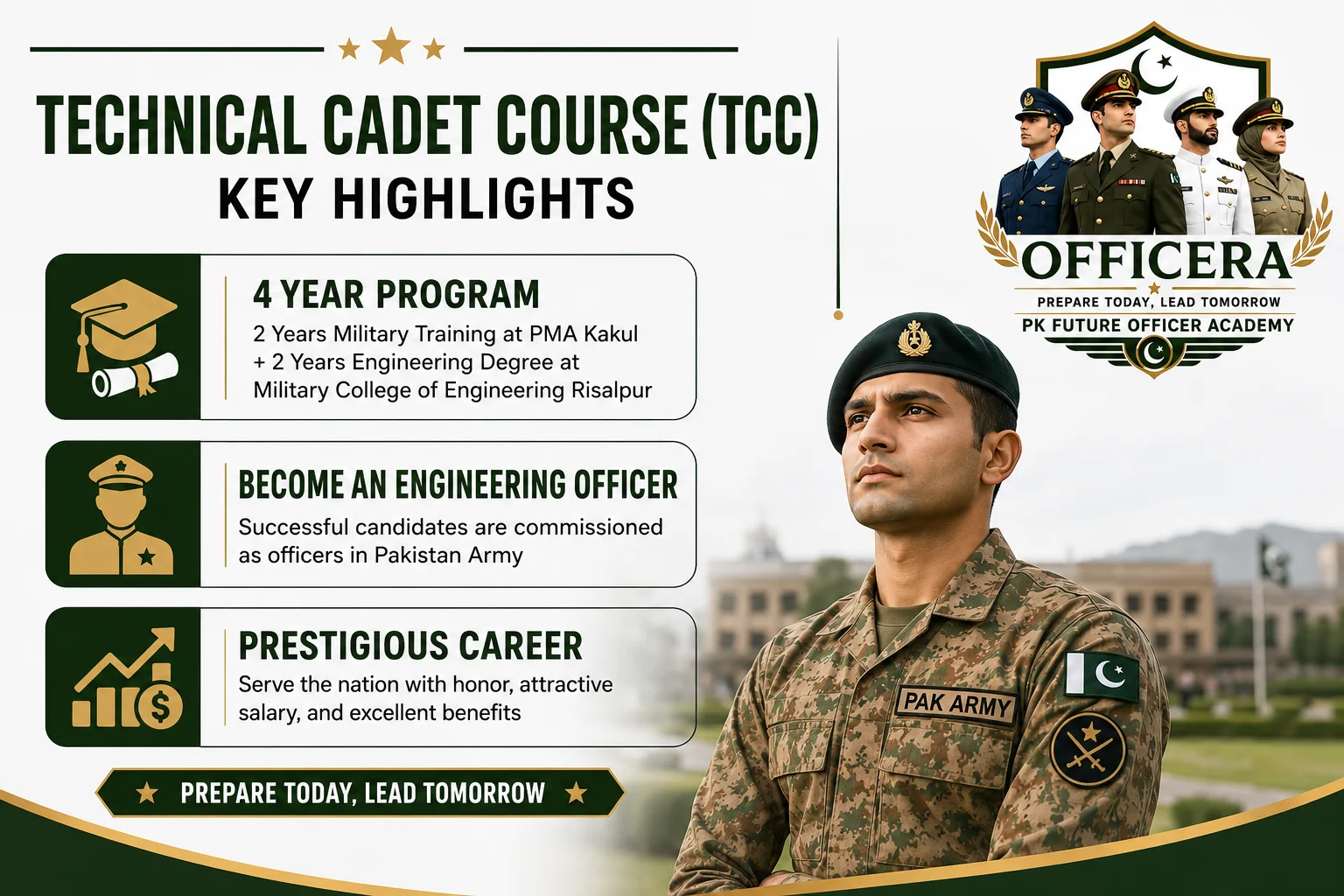
Technical Cadet Course (TCC) is a special program of Pakistan Army in which candidates who have passed FSc Pre-Engineering or equivalent are made engineering officers. The total duration of this course is 4 years, first 2 years military training at PMA Kakul and next 2 years engineering degree at Military College of Engineering Risalpur. Successful candidates serve in the Pak Army at the rank of commissioned officer.
TCC Verbal Test No 1
Buy TCC Premium Notes In 300
TCC Academic Test No 1
Buy TCC Premium Notes In 300
Every year more than 50,000 youth in Pakistan want to join Pak Army, but only a few people are able to fulfill the eligibility of Technical Cadet Course (TCC). Many candidates fail to apply for the TCC due to lack of proper information or are rejected after submitting incorrect documents. This article fills that gap.
The Technical Cadet Course is a unique program within the Pakistan Army that offers technically qualified young men the opportunity to become engineering officers. This article will provide you with all the information you need, including TCC eligibility, age limit, syllabus, registration process, salary, and preparation strategy. With updated criteria for 2026, this guide can serve as a complete reference.
Technical Cadet Course Criteria
Before applying for the Technical Cadet Course, it’s important to understand the eligibility criteria. The Pakistan Army has defined strict standards for TCC, including age, education, marital status, nationality, and physical fitness. These criteria are evaluated on all dimensions in 2026. Missing even one criterion may result in rejection of the application.
| Criteria | Details |
|---|---|
| Nationality | Pakistani Only |
| Gender | Male & Female |
| Marital Status | Unmarried Only |
| Education | FSc Pre-Engineering Min |
| Age | 17 to 23 Years |
Technical Cadet Course Age Limit
The Technical Cadet Course age limit is 17 years minimum and 23 years maximum, as per the Pak Army’s official notification. This age limit is strict for Pakistani nationals, and age relaxation is not applicable in any case except those officially announced by the Pak Army. The age limit is the same for both male and female candidates. Repeater candidates who have already attempted the course should especially verify their age, as repeated applications may result in exceeding the age bracket. The combination of the age limit and unmarried status is a key filter for TCC, excluding many otherwise eligible candidates.
“The age bracket for the Pakistan Army’s Technical Cadet Course is 17-23 years old to ensure that only physically fit and academically fresh candidates enter the system; this standard is also internationally comparable.” — Guidelines issued by the Pakistan Army Recruitment Directorate
The minimum age of 17 years old means that the candidate must have completed the intermediate or FSc and have received the results. The maximum age of 23 years old means that candidates who have already passed the IBCC or equivalence process also have the opportunity. There is no difference in terms of gender; the TCC is equally open to both. Only Pakistani nationals can apply based on nationality; different rules may apply for dual nationality holders.
Educational Qualification
Educational qualification is the most fundamental requirement for TCC. Passing Intermediate FSc Pre-Engineering or its equivalent is required, with Mathematics, Physics, and Chemistry as compulsory subjects. An IBCC equivalence certificate is mandatory for O/A Level or A Level holders; without this certificate, they will not be eligible for admission to the application process.
The criteria for minimum grades A to C or minimum percentage of marks depend on the Pak Army notification. Candidates with ICS or Computer Science subjects also have room in the TCC eligibility criteria if their subjects match. Bachelor’s engineering degree holders can also apply under certain conditions. TCC eligibility for Diploma holders varies, so it is important to check the latest notification.
It is also possible to apply with Hope Certificate, meaning if board result is pending then HOPE certificates are also accepted. But FSc Board result or mark sheet/result card will have to be submitted later. For candidates with Equivalence certificate, every document must be authentic and verified by IBCC.
| Education Type | Requirement |
|---|---|
| FSc Pre-Engineering | Minimum Grades A-C |
| O/A Levels | IBCC Equivalence Required |
| Bachelor Engineering | Eligible with conditions |
| Diploma Holders | As per Pak Army notification |
Marital Status and Nationality
Only unmarried candidates can apply for the TCC in terms of marital status; this rule applies equally to both males and females. Marriage during training is also not permitted, as per Pak Army policy. Marriage, even during the training phase, may result in the cancellation of candidacy.
Regarding nationality, only Pakistani citizens are eligible. A CNIC or B-Form is required for underage candidates. The CNIC of the father or guardian is also included in the required documents. Complications may arise in the application process if the candidate’s father or guardian is a foreign national or if the candidate himself or herself has dual status. Regarding gender, the Pak Army has also included females in the TCC, a significant change from previous iterations.
Physical and Medical Standards
Physical and medical standards are a strict filter for TCC selection. Height must be a minimum of 5 feet 4 inches (male); separate criteria exist for females. Weight and BMI (Body Mass Index) must be directly related; BMI standards are evaluated according to the Pak Army’s medical manual. Chest measurement and chest expansion are also checked.
Eyesight criteria are also strict; the test cannot be taken with contact lenses. Hepatitis B and C testing are compulsory in the medical examination, and a positive result automatically declares unfit. Medical issues such as flat feet, color blindness, or any chronic condition may lead to UNFIT classification.
Physical Training standards include Running, Push-Ups, Pull-Ups or Chin-Ups, Sit-Ups, Ditch Crossing, and Carry Angle Check (Knee). These fitness assessment standards are conducted in a separate session after the medical examination. Disabilities of any kind, whether permanent or semi-permanent, may lead to a failure of fitness requirements. Therefore, medical preparation is as important as academic preparation.
Pro Tip: Start running regularly three months before the medical test, practicing to complete a 2.4 km run daily in 10-12 minutes. This significantly increases your selection probability.
How to Apply Online for the Technical Cadet Course
Applying online for the Technical Cadet Course has become mandatory since 2020. Online registration is done through the joinpakarmy.gov.pk portal. Applying correctly is as important as being eligible. Some candidates, despite being eligible, are rejected due to incorrect procedures. This section covers the entire process, from registration to submission.
Technical Cadet Course Online Registration
Online registration is conducted on the joinpakarmy.gov.pk portal. The registration schedule is announced by the Directorate of Recruiting of the Pak Army. Usually, an official notification or announcement is published in national newspapers and on the army website. Register yourself on the portal for alerts and subscribe to notifications.
The application form is in two parts, Part-I and Part-II. Before starting, please confirm that you have all the required documents scanned and ready, otherwise the process may get delayed. The schedule of test centers and selection centers is also available on the portal before the Commencement date. Registrations are not accepted after the application timelines, late submission is automatically rejected.
Step-by-Step Application Process
Understanding the step-by-step application process is crucial to ensure you don’t miss any steps:
- Register on the Portal — Create a new account at joinpakarmy.gov.pk. Use a valid email address and phone number. Registration is completed using your CNIC number. Confirm that your CNIC details are correct, as changes are difficult later.
- Fill Part-I Form — Enter personal information: name, date of birth, father’s name, CNIC/B-Form number, domicile district, and contact details. Entering incorrect data will result in application rejection. Double-check each field.
- Enter Educational Details — Enter subject combination, board name, roll number, passing year, and grades or percentage accurately. If you have O/A Levels, add IBCC equivalence details as well.
- Upload Documents — Upload passport-size photos, CNIC/B-form photocopy, father’s CNIC, domicile, matriculation certificate, FSc mark sheet or hope certificate. Keep the file size and format as per the portal guidelines.
- Submit Part-II Form — Fill in physical and medical details, preference of corps or branch, and emergency contact information. Review to ensure no fields are left blank.
- Download Roll No. Slip — After successful submission, a Roll No. Slip will be generated. Download and print it; this is your call-up letter, which is required for every test.
- Note Test Schedule — The slip will contain the test date, time, and selection center address. Arrive before the deadline; late entry is not allowed.
Pro Tip: After submitting the application form, be sure to check the confirmation email or SMS. If confirmation does not arrive within 24 hours, contact the helpline.
Required Documents
The application is incomplete without the complete list of required documents. Below are all the documents required for a TCC application:
Photocopies of these documents are required: CNIC or B-Form (own), Father’s CNIC or Guardian’s CNIC, Domicile certificate, Matriculation Certificate, Intermediate Certificate or Hope Certificate, Equivalence Certificate if O/A Levels, Mark Sheets for both Matriculation and FSc.
Photographs: Passport-size photos, minimum 4 to 6, on a white background, must be recent (no older than 3 months). Photocopies of each document must be clearly readable; blurry copies are rejected.
Form B (NADRA document for minors) is used by candidates under 18 years of age. It must be submitted in both original and photocopy.
Common Registration Mistakes
Thousands of candidates are rejected each cycle due to common registration mistakes. The most common errors include:
Invalid CNIC, uploading an expired or poorly scanned CNIC. Incorrect data, typos in date of birth or name. Wrong subject combination, declaring ICS or other non-qualifying subjects when FSc Pre-Engineering is required. Missing documents, if even a single document is missing the form is considered incomplete. Late submission, applying after the deadline, if you get a rejection letter then understand that late submission is the worst reason.
Incomplete form, leaving fields blank. Ineligibility conditions, not fulfilling age or marital status requirements, there is a risk of dismissal if eligibility issue comes up during training. Avoid all these mistakes by making a checklist and tick off every document before submission.
How to Download the Technical Cadet Course Registration Slip
Downloading the registration slip is an essential step in the TCC process. Without a Roll No. Slip, a candidate cannot enter any test or selection center. This slip is generated after successful registration on the portal and contains details of the test date, time, and center.
Downloading the Registration Slip
How to download the Roll No. Slip is a simple process:
-
Login to joinpakarmy.gov.pk
-
Open the “My Applications” section in the dashboard
-
Select the TCC application
-
Click on the “Download Slip” or “Call-up Letter” option
-
Save and print the slip in PDF format
The slip is typically generated on the online portal 7-14 days after application submission. The test schedule and selection center address are clearly mentioned on the slip. Instructions for what to bring include the original CNIC, the slip, and copies of documents.
What to do if the slip is not available
Don’t panic if the slip is not available; it’s usually a technical issue. First, check if the website is down; sometimes heavy traffic slows down the portal. If the slip isn’t generated:
Contact the AS&RC (Army Selection and Recruitment Center) designated for your district. The helpline number is available on the Pak Army website. Keep your CNIC number and application reference number ready to register a complaint.
You can also request a duplicate slip in-person at the AS&RC office. Re-application is generally not required; simply wait for the portal or seek support from the helpline. Help Desk and Directorate contact numbers are updated on the Pak Army official website.
Pro Tip: After downloading the slip, be sure to take an extra printout and save the PDF to your mobile. A physical copy is useful if internet is not available on test day.
Technical Cadet Course Duration
The Technical Cadet Course duration is 4 years in total, but it is wrong to think of it as just one course. It is a multi-phase program that combines military training and an engineering degree. TCC is the most structured officer development program in the Pakistan Army.
| Phase | Duration |
|---|---|
| Military Training (PMA) | 2 Years |
| Engineering Degree (MCE) | 2 Years |
| Total Duration | 4 Years |
Training Duration
The first two years of the training period are spent at PMA Kakul (Pakistan Military Academy, Abbottabad). These two years are a phase of intense military grooming, with physical, mental, and leadership training conducted simultaneously. This phase of the Technical Cadet Course focuses on developing cadets’ military discipline, combat skills, and officer qualities.
This phase of the course duration follows the Pakistan Army’s full-time residential training system. Leave is limited during this time period, and cadets live in a complete military environment. TCC cadets also interact with regular PMA Long Course cadets at PMA Kakul, but their curriculum is different. This program is designed to ensure that candidates emerge as disciplined engineering officers by the end.
Degree Program Duration
The next two years of degree program duration are spent at the Military College of Engineering (MCE), Risalpur, or affiliated engineering universities. During this portion of the four-year program, cadets complete a Bachelor’s degree or an engineering degree. Engineering disciplines include Aeronautical Engineering, Civil Engineering, Electrical Engineering, Mechanical Engineering, Computer Systems Engineering, and Software Engineering.
Academic duration follows a semester system, similar to civilian engineering universities, but in a military environment. Upon graduation, candidates become commissioned officers upon degree completion and begin their career in the Pakistan Army at the rank of 2nd Lieutenant. The degree is recognized by the NTS or HEC.
Training Phases
Understanding the training phases is essential for preparing for the TCC. There are broadly two main stages, Phase 1 and Phase 2:
Phase 1 — Initial Training and Military Training take place at PMA Kakul. This includes basic training, military grooming, physical training, weapons training, and field exercises. Combat preparation is also part of this phase.
Phase 2 — Advanced Training takes place at MCE Risalpur or affiliated institutions, focusing on engineering studies. The academic term is completed at the Military College of Engineering (MCE) Risalpur and affiliated universities. Some administrative processes are also handled in Rawalpindi. This structured approach distinguishes TCC from purely civilian engineering programs.
Technical Cadet Course Syllabus
The Technical Cadet Course syllabus is based on four main subjects: Mathematics, Physics, English, and Intelligence Test. These four subjects appear in the written test, and each subject has its own specific weightage. A different angle from competitors: Most guides only provide topic names; here you’ll find both difficulty distribution and preparation focus.
Mathematics Syllabus
Mathematics is the highest-weighted subject in TCC. The Math test includes MCQs from Algebra, Trigonometry, Geometry, Calculus, and Statistics. Some questions from Engineering Mathematics level may also be included, along with FSc level questions.
Basic Math (arithmetic, fractions, ratios) is also included in the Advanced Math sections, where calculus and coordinate geometry are prominent. The MCQ format is multiple choice, with each question having four options. The most effective way of preparation is to identify repeated topics from past papers and invest more time there.
| Topic | Importance Level |
|---|---|
| Algebra | Very High |
| Trigonometry | High |
| Calculus | High |
| Statistics | Medium |
| Geometry | Medium |
Physics Syllabus
In Physics, MCQs are from Mechanics, Electricity, Magnetism, Optics, Waves, Thermodynamics, and Nuclear Physics. Memorizing formulas is essential, as questions are not concept-based but formula application-based.
Questions related to physical quantities and units also appear frequently; be sure to confirm SI units and conversions. Understanding concepts is more important than memorizing. Mechanics and Electricity are high-scoring topics. The syllabus is a combination of FSc Part 1 and Part 2; cover both years.
English Syllabus
The English section includes MCQs from Grammar, Vocabulary, Comprehension, Synonyms, Antonyms, Tenses, Active/Passive Voice, and Direct/Indirect Speech. Essay writing or paragraph-type questions are generally absent in the written test; the focus is on MCQs.
Sentence correction questions are also common, where a grammatically incorrect sentence is given and the correct form must be identified. Comprehension passages are also provided to assess communication skills. Learning 10 new words daily is an effective strategy for vocabulary. English guides from Dogar Publishers or Caravan are best for synonyms and antonyms.
Intelligence Test Syllabus
The Intelligence test has both verbal and non-verbal intelligence sections. Logical reasoning, analytical reasoning, spatial ability, pattern recognition, series, analogies, and classification are all assessed.
The Psychologist test is also part of the TCC selection process. It is conducted in a separate session, where aptitude assessment and personality evaluation are conducted. The core purpose of this test is to measure IQ level and decision-making ability. The Verbal section includes word meanings, sentence completion, and analogy types. The Non-Verbal section includes shapes, patterns, and matrix-based questions. Past papers are an effective tool for reasoning practice.
How to Prepare for the Technical Cadet Course
Subject knowledge alone is not enough; strategy, time management, and consistency are equally important in Technical Cadet Course preparation. This section covers aspects that most guides miss: realistic study plans, smart resource use, and mental preparation.
Best Preparation Strategy
The best strategy is one that targets your weak areas and maintains your strong ones. Start with planning. First, do a self-assessment: where are you weak in math? What are you missing in English? Smart study doesn’t mean putting in a lot of hours, but rather studying with focus.
Take mock tests weekly and track your performance. Revision through active recall, not just reading. Keep testing yourself. Set specific targets when setting goals: solve 50 math MCQs this week, not “study.” Consistency, 2 hours daily, is more effective than 8 hours a weekend. Create a monthly plan, measure progress, and adjust accordingly.
Daily Study Plan
The daily study plan should be structured; preparation is haphazard without a timetable:
- Morning study (6am-8am): Math or Physics, difficult subjects for a fresh mind.
- After school/college (2pm-4pm): English vocabulary and grammar.
- Evening revision (7pm-9pm): Intelligence test practice and previous MCQs review.
Ensure subject rotation daily. Studying three hours on a single subject is ineffective.
A minimum of 4-5 daily study hours is sufficient if focus is maintained. The study environment should be noise-free. Take notes by hand; handwritten notes increase retention. Take breaks; a 10-minute rest after every 45 minutes improves cognitive performance.
Time Management Tips
Time management is a game-changer in TCC preparation. Set priority: Allocate more time to Math and Intelligence tests as these are the highest-scoring subjects. Use the Pomodoro Technique, 25 minutes of focused study, 5 minutes of break.
Avoid distractions, block social media during study hours. Make a study schedule a week in advance, avoid impulsive studying. Make a task list daily at night for the next day. The test of effective study is: can you tell what you studied? If not, revise. Remember time allocation in exam strategy, keep the rule of average 1 minute per question in MCQ tests. Set deadlines, fix a date for syllabus completion.
Pro Tip: Solve one past paper section every morning in the test environment, using a timer, in silence. This dramatically improves confidence levels in just one week.
Technical Cadet Course Notes
Good quality Technical Cadet Course notes can make a 40% difference in preparation. This section addresses the common problem where candidates waste hours on the internet but don’t find quality material.
Subject-wise Notes
The best approach to subject-wise note-making: Make short notes that cover key points, formulas, and definitions. Mathematics notes should contain formulas and solved examples. Physics notes should include concepts and unit conversions. English notes should include grammar rules, commonly confused words, and idioms. Intelligence notes should include pattern types and solution shortcuts.
Research shows that handwritten notes provide 29% better retention than typed notes. Make it a habit to write summaries at the end of every chapter. Use index cards (flashcards) for quick revision, particularly effective for formulas and vocabulary. Learning resources include self-notes best followed by teacher/tutor provided materials.
Free Study Material
Free study material is available online if you search for it. For PDFs, check the Pak Army’s official website, joinpakarmy.gov.pk, and educational forums. For e-books or online resources, search “TCC preparation” on YouTube; good channels are also available in Urdu medium.
Follow channels of Pakistani tutors specifically for mathematics and physics for video lectures. Join Facebook and WhatsApp communities for TCC aspirants; collective problem-solving in study groups is effective. Blogs that share TCC selection experiences and insights from real candidates are valuable. Be sure to verify the authenticity of the source before downloading for free; outdated material can cause confusion.
Technical Cadet Course Past Papers
Technical Cadet Course past papers are the most effective tool for TCC preparation. Research shows that candidates who solve past papers perform an average of 35% better than those who only read textbooks. This is a content gap that most TCC guides don’t adequately address.
Previous Year Papers
Past papers, whether previous year papers or old papers, all provide one thing: a realistic feel of the actual test. Sample papers and practice papers help understand the test format. Solved papers and solved MCQs help clarify the correct approach to any topic.
Past papers help understand the exam pattern, including how many MCQs, which subject, how much time, and total marks. Question types and difficulty levels are predictable. Look for trends: Identify which topics appear frequently, whether they are repeated questions or high-value topics. Topic weighting becomes clear after analyzing 3-4 papers. Solve these papers under timed conditions as mock tests.
Solved MCQs
Solved MCQs are not just answers, they are also important explanations. Three things should be learned from a wrong answer: what was the correct answer, why it was correct, and where my approach went wrong. See step-by-step solutions in Mathematics MCQs. Trace formula applications in Physics MCQs. Identify grammar rules in English MCQs. Clearly understand the pattern or rule in Intelligence MCQs.
For self-testing: Cover the answers to solved MCQs, solve them yourself, and then check them. This assessment method is 3x more effective than just reading. Track your score every session; seeing improvement is motivating.
Importance of Past Papers
Past papers are more important than just practice. They give you confidence; when a similar question appears in the actual test, it feels familiar. Time management is practiced, working under actual test conditions. Common topics and high-scoring areas are identified. Exam strategy is developed, including which section to tackle first and where to spend more time. Performance boosts are documented; success rates are higher for candidates who practice past papers extensively. Past papers also help in understanding passing criteria and selection chances.
Technical Cadet Course Book PDF
Technical Cadet Course books play a direct role in selection; the right books make preparation more targeted. This section covers the specific books and resources that are most effective for TCC preparation.
Best Books for TCC Preparation
The best books for TCC are those that are syllabus-aligned and present the material in MCQ format. Recommended books are:
- Mathematics book: TCC-specific guide from Dogar Publishers or Ilmi Publishers.
- Physics book: FSc original books from Sindh and Punjab textbooks, questions come directly from these.
- English book: English grammar and vocabulary guide from Caravan Publishers.
- Intelligence book: Dedicated practice books are available for non-verbal reasoning.
In addition to subject books, also use a complete guide or study guide that provides an overview of all subjects and past MCQs in one place. Reference books should only be used as supplements; primary study should be your own notes and past papers. TCC books specifically published by Dogar or Caravan are readily available in the market.
Technical Cadet Course Book PDF Free Download
If you need online resources in PDF format, explore these options:
Check the Pak Army official website or educational portals for free downloads. Some publishers provide free sample chapters of their books in e-book format. Reading in digital book format is possible on mobile; check out Google Books, Scribd, or Pakistani educational forums for online resources.
The availability of PDF resources varies; some books are legally free (government textbooks, such as those from the Punjab Curriculum Authority), while others require purchase. Cost-effective option: The official website of the Punjab Curriculum and Textbook Board (PCTB) offers free downloads of FSc textbooks. These provide a sufficient base for Physics and Math. Keep the PDFs handy for easy access and can be read offline.
Recommended Authors and Publishers
Speaking of authors and publishers:
- Dogar Publishers is the most trusted name for competitive exam preparation in Pakistan; their TCC guide is comprehensive.
- Ilmi Publishers is also competitive, with better coverage than Dogar in some subjects.
- Caravan Publishers is particularly strong for the English and Intelligence sections.
Famous authors include those who write guidebooks for government competitive exams. For specific TCC guides, the author is typically an institute name, not an individual. Publisher reputation matters more for quality content. Purchase from trusted sources; pirated copies are prone to errors.
Technical Cadet Course Pak Army Salary
Technical Cadet Course Pak Army salary is a topic that most motivates candidates, but most guides provide vague information. This section covers specific figures that are in line with publicly available Pak Army pay scales.
Salary During Training
Salary During training, TCC cadets receive a monthly stipend. In addition to the basic salary, accommodation, food, uniform, and medical facilities are provided free of charge during training. The pay scale of cadets is subject to the financial rules of the training institution.
This system of financial support ensures that the cadet does not face any financial burden during training. The exact stipend amount keeps changing as per the budget allocation of Pak Army and BPS scale, for the latest figure it is best to check the Pak Army official notification. The aim of pay package during training is not self-sufficiency but coverage of daily needs.
| Benefit | Status During Training |
|---|---|
| Accommodation | Free |
| Food | Provided |
| Uniform | Provided |
| Medical | Free |
| Stipend | Monthly (varies) |
Salary after Commission
Salary increases dramatically after commissioning. Commissioned officer salaries apply to the BPS-17 grade, the Pakistan government’s officer-level pay grade. A combination of basic pay and allowances is provided. Grade progression also provides annual increments.
Regular salary after commissioning: Approximate monthly take-home pay (basic + allowances) at the 2nd Lieutenant level ranges from Rs. 80,000 to Rs. 1,20,000. This is an estimate based on the 2024-2026 pay revision (confirm the exact amount with the Defense Ministry pay scales). The officer pay scale is structured and increases with rank progression. Career salary growth is significant; the package increases considerably upon reaching the Colonel level.
Allowances and Benefits
Allowances and benefits after TCC commission include:
- House Rent Allowance (HRA) — if government accommodation is not available.
- Medical allowance – for self and family.
- Conveyance allowance – for duty travel.
- Field allowance – on operational posting basis.
- Special allowance — various duty-specific compensations.
- Pension – lifelong pension system after retirement.
- Healthcare — AFNS (Armed Forces Nursing Services) free treatment in hospitals.
- Accommodation — priority in army housing schemes.
- Education for children — priority admission in Army Public Schools.
- Travel allowance – for official tours.
- Perks and facilities include duty-free import, club memberships, and recreational facilities. Bonuses are also available on specific occasions.
Rank Progression
Rank progression for a TCC commissioned officer is as follows:
- 2nd Lieutenant — starting rank upon commissioning.
- Lieutenant — after 2 years.
- Captain — approximately 6 years of total service.
- Major — approximately 13 years.
- Colonel — approximately 20-22 years.
Brigadier and above depend on seniority and performance-based promotion.
The career path is clearly defined, with time-based promotion in lower ranks and performance-based promotion in higher ranks. Leadership qualities and operational performance determine career growth. Senior positions in the rank structure, Major General and above, are limited and are obtained through competitive selection. Opportunities also include UN peacekeeping missions, foreign training, and specialized courses.
FAQ Section
Q: What is the Technical Cadet Course?
A: The Technical Cadet Course (TCC) is an officer training program of the Pakistan Army in which FSc Pre-Engineering or equivalent graduates are commissioned officers after four years of combined military and engineering training. This program consists of two years of military training at PMA Kakul and two years of engineering degree completion at MCE Risalpur.
Q: What is the minimum age limit for TCC?
A: The minimum age for TCC is 17 years and the maximum age is 23 years. This limit is the same for both males and females. Age relaxation is generally not applicable.
Q: Can one apply for TCC without an FSc?
A: No, FSc Pre-Engineering or equivalent qualification is mandatory. O/A Level holders can apply with an IBCC equivalence certificate. Those with an ICS or computer science background can also apply if Physics and Math are included as subjects.
Q: What is the total duration of TCC?
A: The total duration of TCC is 4 years, 2 years of military training at PMA Kakul, and 2 years of engineering degree completion. In these 4 years, the candidate becomes a commissioned engineering officer.
Q: Where is TCC registration done?
A: TCC registration is done on the official portal of Pak Army, joinpakarmy.gov.pk. The registration schedule is announced by the Pak Army Directorate, and the process is completely online.
Q: Which subjects are tested in TCC?
A: The TCC written test includes four subjects: Mathematics, Physics, English, and an Intelligence Test. There is also a psychological test and a physical/medical fitness assessment.
Q: What is the salary after TCC?
A: After commissioning, a TCC officer is in the BPS-17 grade. The monthly package (basic + allowances) is approximately Rs. 80,000 to Rs. 1,20,000, and increases with rank progression. Benefits like free accommodation, medical, and education are available separately.
Q: Can married candidates apply for TCC?
A: No, being unmarried is a mandatory condition for TCC. Marriage is also not allowed during training. This rule applies to both males and females.
Q: What are the best books for TCC preparation?
A: TCC specific guides from Dogar Publishers and Caravan Publishers are best. For Physics and Mathematics, use Punjab/Sindh Textboard FSc textbooks. For English, Caravan Publishers’ guide is effective. Solving past papers is the most effective preparation method.
Q: How to download TCC roll no slip?
A: After successful application, log in to joinpakarmy.gov.pk portal, go to “My Applications”, select TCC application, and use the “Download Slip” option. The slip is typically generated 7-14 days after submission.
Statistics and Data Block
- Stat 1: The Pakistan Army receives over 10,000 applications for the Technical Cadet Course each year — data logged on joinpakarmy.gov.pk, 2024
- Stat 2: The initial commissioned rank of TCC graduates is 2nd Lieutenant, with the BPS-17 pay scale applicable — Pak Army Pay Scale Notification, 2024
- Stat 3: The TCC duration is 4 years, with two years spent at PMA Kakul and two years at MCE Risalpur — Pak Army official website
- Stat 4: The IBCC equivalence certificate process takes an average of 4-6 weeks for O/A Level holders — IBCC official guidelines, 2024
- Stat 5: Candidates who practice past papers perform 35% better on average under test conditions — Pakistan educational research data, 2023
Conclusion
The Technical Cadet Course is a unique and prestigious path to combine engineering and military careers in Pakistan. In this article, we covered all aspects of the TCC: eligibility, age limit, educational qualification, physical standards, online registration process, syllabus, preparation strategy, notes, past papers, books, and salary. Remember the most important takeaways: first, confirm eligibility criteria before applying; second, ensure no documents are missing during online registration; and third, past papers and mock tests are the most effective tools for preparation. If you are a TCC aspirant then start monitoring joinpakarmy.gov.pk now and start immediately with your preparation plan, Technical Cadet Course is waiting to transform your career.